Maps

Tuesday, July 14, 2015

THE COOL, COOL RIVER


"It was our sense of parody. The whole technique of exploring has a jargon so flashily impressive and so easily guyed that we found it impossible not to talk of our plans without pretension . . . If Indians approached us, we referred to them as the Oncoming Savages. We never said 'Was that a shot?', but always 'Was that the well-known bark of a Mauser?', All insects of harmless nature and ridiculous appearance we pointed out to each other as creatures 'whose slightest glance spelt Death'.
-Peter Fleming, Brazilian Adventure


There may not be a word that evokes more romance or adventure than 'Amazon'. To me, and countless others, it is dense jungles, killer spiders, murderous piranhas, mysterious sounds and a thousand ways to perish. The ability to vanish without a trace, as Percy Fawcett did in the summer of 1925 (prompting the quoted book and so many others) has left the Amazon with  the kind of mystery and treachery that has secured its reputation for generations. 


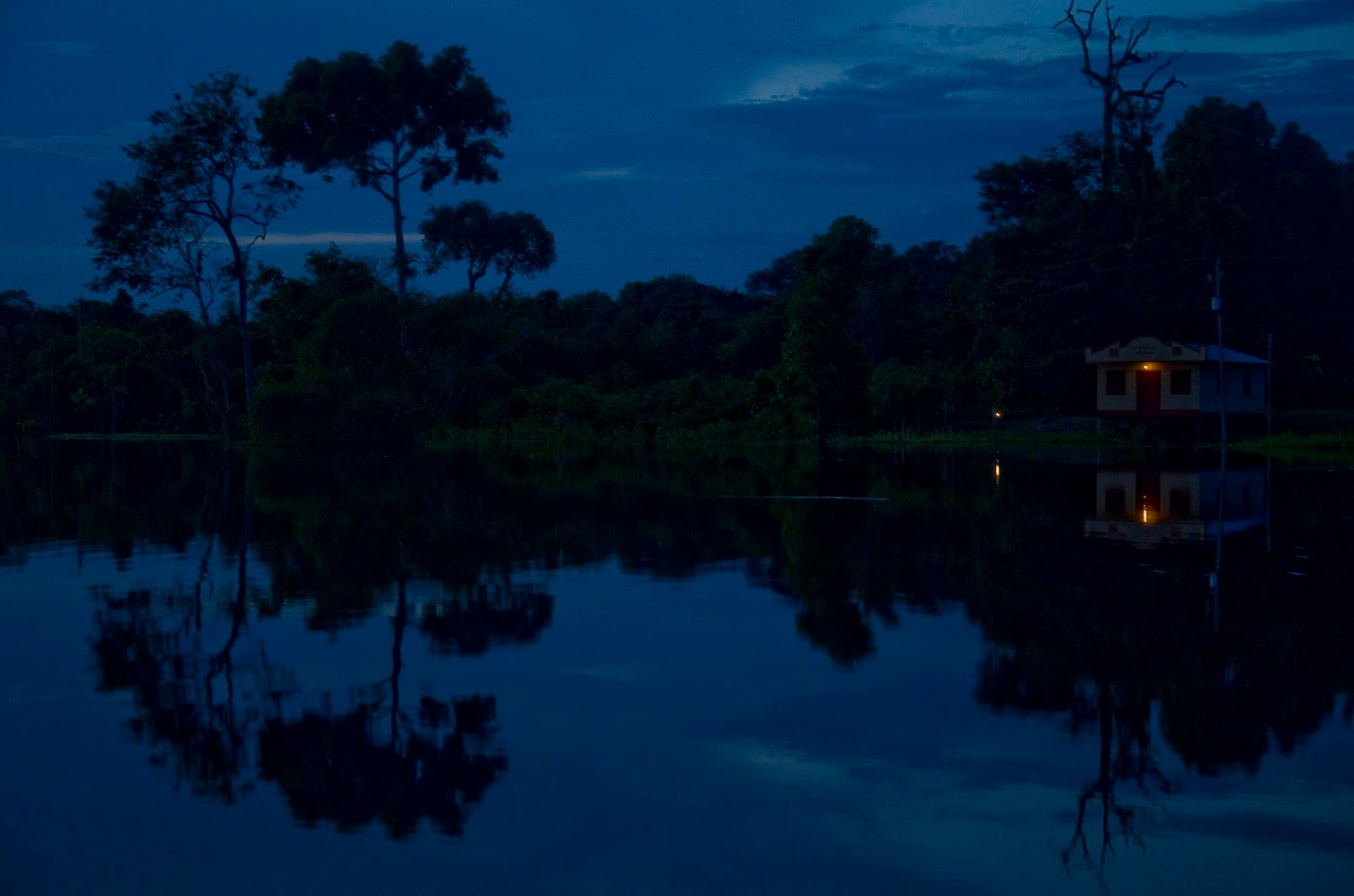
Travel to the Amazon has become tamer. We flew into Manaus comfortably, boated to a lodge in the middle of the floods, and not once were we murdered by a spider, ants, fish, monkeys, or people. To be fair, I'm an out of shape office worker, so I chose not to chart a part of the jungle that is still unmapped. I'm pretty sure there are places still unvisited within the jungle, but for most of us the visit will feel less adventurous than our boyhood conception of the Amazon has led us to expect. 


Manaus is oddly representative of the Brazilian city. When demand for rubber made the Amazon the richest forest in the world, Manaus was awash in money. For a decade or two it was one of the most ostentatious cities in the world. It was the first city with electricity in Brazil, boasted a copy of a French operahouse, and was a frequent if out of the way stop on world tours by dignitaries and performance groups. By 1909 synthetic rubber was created and rubber tree seeds had been smuggled out of Brazil, and by the 1930s the natural rubber trade was essentially dead, and Manaus met the same fate as Ouro Preto or early Sao Paulo. The city shows this. There are 4 blocks of historic Manaus, with run-down but once-magnificent buildings. Many are abandoned, and few are in good repair. The rest of the city is grey concrete block buildings. And at all moments there's the suspicion that, given a few minutes of inattention, the jungle will take the place back over.


The river, and the jungle, are a different matter. The grip of civilization loosens disturbingly quickly the further one travels. There is one highway, apart from the river itself, that connects Manaus to the rest of Brazil. It's two lanes, and washes out most years during the floods. The lodge we stayed at required a 30 minute boat ride through flooded trees and reeds, and homes were harder to get to than that. Electricity may have arrived first in Manaus, but electricity 50 miles from Manaus only arrived in homes in 2013. 


It was only a few days, but I'm so glad I went. It's a very different Brazil than anything I've seen so far. People's lives in Amazonas are tied to the river, and its fascinating to see how global society, which is distinctly not designed for the Amazon basin, is adopted (or not) by people living there. The experiences of hiking through the jungle, the disturbing call of howler monkeys, our guide Nigel belly flopping onto a caiman, chasing birds along the river in our boat, and the sunsets, they're unforgettable and nearly impossible to replicate. The adventure is there, though substantially tamer. But Fawcett's fate still hasn't been discovered, so there's still room for a new adventure.




Sunday, June 28, 2015

IT'S WHAT LAS VEGAS WOULD BE IF IT WERE RUN BY NED FLANDERS


"Mini Mundo Park, of Gramado, RS, is adept at anything that connotes creativity, joy and beauty. This year we were partners in a beautiful story of romance, constructed to the minutest detail - a proposal of marriage in our park."
A poor translation from the Jornal do Mini Mundo


The quotation above was from the most recent edition of the Jornal do Mini Mundo, a hard-hitting quarterly produced by the owners of Mini Mundo, a park of miniature landmarks. It's pretty serious; there's an interview with park management, opinion pieces, community stories, and coverage of the many events happening amongst the miniatures of Mini Mundo. And coverage of a proposal, which is on YouTube if you really want to see what it would look like to ask someone to marry you next to a six foot tall rendition of Schloss Neuschwanstein.


This blog is on record comparing Gramado to Park City. Another, perhaps more accurate comparison is Branson, Missouri (hence the title). Gramado is an interesting town, but there's not really much to do there. So the residents got creative. There are three chocolate companies in the town. One runs The World of Chocolate (you may remember this from a few posts ago), while the other two run their own separate low-budget amusement parks outside of town. Mini Mundo is owned by a large German hotel. There's a Harley Museum, a Hollywood Car Museum, a Museum of Fashion, a Museum of Shoes, a giant thing with enormous Easter bunnies in front of it (since I didn't catch the name, let's just call it Easter Rockin' Fun Zone), Santa Land, Nossa Senhora Land (the picture above doesn't quite capture the scale , , , those hands are about 30 feet tall), and so many more. Actually, every place I went to featured Nossa Senhora at some point, so I guess she's diversified.

Empress Ariel, just after dethroning Santa Claus at Santa Land
I love these places. The campiness of them keeps me giggling, but there's so much more than just small-town charm. I love miniature places, and Mini Mundo was no different. I love them primarily because I get to see all the stories the creators placed into the world they created. When my mom and I were creating a model train set (perhaps the best gift ever given to a child), we had all kinds of stories running in the town. There was a mail truck that had driven into the lake, the busy folks at the train stations, and so on. The small town, nestled beneath the craggy slopes of Mt. Bumpy (child Chris had a way with names) was full of life. And Mini Mundo was too. Its newspaper can attest to that.


Obviously, the fire which broke out in this Swabian townhouse is a pretty obvious one. According the newspaper, the owner is an 89 year old who sleepwalks, and left the oven on after sleep-cooking. Less obvious things were afoot in the town of landmarks. My somewhat blurry photo tried to capture an elderly couple enjoying a day on the grounds of the Museu Paulista (this is likely the closest I'll get to the museum, despite it being about 8km from my house. Only in Brazil can the leading museum of the city be closed until 2025 for renovations). Mini Mundo even operates an airline to service its town, with a fleet of Airbus A340s. The townfolk are quite wealthy, judging from the cars they were driving - historic Aston Martins, Ferraris, and surprisingly, considering its proclivity to flip, a 1999 Mercedes CLK-GTR (for the everyone who reads this and is confused, 30 seconds into this video you'll understand a bit better). There's even a curious accident where a truck carrying normal-sized acorns crashed, complete with bystanders confused by the appearance of full sized acorns. When I go to a place like Mini Mundo, my mind starts to make up stories for everything I see. It's a lot of fun.


While miniature towns are full of stories, low-grade corporate amusement parks are the opposite. They're monuments to absurdism and small-business owners with big dreams. Floribal's Terra Magical delivered in this respect. Florybal's chocolate is not very good, even by Brazil's pretty low standard. But the scope of its magic park was impressive. It covered everything. Dinosaurs, early man, Greek deities, Nossa Senhora and Catholic iconography, a chocolate mine being worked by enslaved elves supervised by a Snow White-esque taskmaster, jungle animals, non-jungle animals, indigenous Brazilians, and pretty much anything else you could make a fiberglass statue of. None were of particularly high craftsmanship, and, like Sao Paulo's roads, there was no apparent order or theme to things. A one minute walk along a pathway wound through penguins and polar bears, gorillas, forest people, a statue of Neptune, a large statue of Christ, and a saber-tooth tiger about to maul a still smiling early human. Terra Magical's strong suit is its dinosaurs, which were slightly more meticulously researched than the rest. Some were animatronic, in style of 1970s Disneyland, complete with bad audio tracks. The even had a Dino Snack Bar.

The wizard, a key feature of the Forest People section

One of the most accurate models in Terra Magical

Even with captions I still couldn't quite figure out who this was. Not sure how the bear feels about this whole thing


She's pretty happy. What you can't see is that her husband is about to be eaten by a tiger.

Perhaps my favorite part was the deity grotto, where statues of a bunch of deities were arrayed in no particular order, and with no explanation. The grotto was on a road flanked by dinosaurs, just before you get to Indigenous Brazil Land. No signs, no explanation as to what's going on. Just a pre-fab pool, surrounded by stones, with nine gods from different religions having a pool party. Gramado is a very entertaining place to visit, though perhaps not for the intended reasons.


Monday, June 22, 2015

WHERE THE TRAILS RUN OUT AND STOP


'And beyond the nameless timbers I saw illimitable plains'
-Rudyard Kipling, The Explorer


Work has conspired to bring me again to Brazil's Uruguay, Rio Grande Do Sul. Work was dispensed with easily enough, and I was left with a long weekend to get to know the Gauchos a little better. Porto Alegre, in strictly geographical terms, is in a stunning location among hills, a lake, and a river. It is gritty, a juxtaposition of styles and ways of life which encapsulates so much of the modern Brazilian city.


Rio Grande do Sul, outside of the cities, is an entirely different matter. Rolling green and gold hills, cattle towns, and German villages nestled in the crooks of the foothills. It's a landscape at once both dramatic and pastoral. I stopped for the night in Gramado (mentioned in an earlier post, and soon to be featured in another post . . .), where crowds of scarved and shivering Brazilians bragged through WhatsApp about how cold it was there. It was 53. It was a charming town to spend a fall evening with a pot of fondue.


The new places to see this trip were the canyons and national parks near Cambara do Sul, along the border with Santa Catarina. Cambara do Sul itself is described by Lonely Planet as a "dusty frontier town", which I think sums up it up nicely. I spent the afternoon driving on an unpaved highway to Itaimbezinho, an abrupt gash in a mountainous plateau that opens into a sea level plain and the Atlantic Ocean. The hike was deserted and peaceful. After months in Sao Paulo, I've come to appreciate the color green and solitude of a national park quite a bit more. The weather cleared up and left me with a sunny view of a remarkably unexpected canyon. After 20 miles of dirt roads I was back in Cambara do Sul, and the only diner at one of the two restaurants in town.


I set off the next morning for Canion Fortaleza, which involved driving on a muddy logging road for 45 minutes. Somewhere early in the day the front tire of my Hyundai catastrophically failed, so I spent part of the day changing a tire as a tired dog and surprisingly curious cow watched (but didn't offer any assistance). But, after a long and bumpy journey and a few close calls with the mud, I arrived at the trail head, and thankfully ahead of a large tour bus. It was all worth it. Fortaleza is less sharp as canyons go, but deep and enormous. It was a hike well worth the effort.


I passed back through Gramado on the way back, but that will be for another post . . .


Monday, May 18, 2015

FOR THE MOMENT INDISTINGUISHABLE FROM THESE BUREAUCRATS


' . . . the planet is becoming supersaturated with displaced humanity. The romance, so powerful a motivation not long ago, has as a result long been entirely stripped from the process of today's travel'
-Simon Winchester, Worlds to Explore


I did not choose to begin with a lament from Simon Winchester because our trip to Rio Grande do Sul ever promised a truly romantic adventure. It did not. We travelled by rented Hyundai HB20, not by donkey or camel or canoe. We even, by generous definition, stayed in a hotel in Torres. But, in reflection, this trip had many of the makings of what great travel is constructed of.


I struggled, on returning to Sao Paulo, to explain what exactly the trip was. What did you see? What did you do? These basics were challenging to answer, without simply (and unsatisfactorily) responding "we travelled". That, as it turns out, is precisely what we did. We had a blast. And we did it despite having the primary event we were aiming for (the Torres Hot-Air Balloon Festival) being something of a bust.


It was a great trip because we saw the place as it really is. We saw Gramado, a mountain tourist town of German extraction, in something of an off-season on an off weekend. The Santa-Land amusement park was nearly empty, and we had the chocolate museum to ourselves. There were no tour buses on the roads through the wine-country, and we ate risotto overlooking a vineyard without hearing ceaseless, buzzword-laced descriptions of the wine. The carnival rides at the balloon festival were populated by four American diplomats and dozens of local Torresian adolescents. In short, it was seeing the place as the people there know it. And it was great.


Of course, Gramado is gimmicky. It's most comparable to Park City (both even have film festivals), but to compare the two is to remove the careful "snobbery meets a real mining town" gravitas of Park City and replace it with a sort of "Disney presents Park City" replica. For those of us who are essentially 8 years olds, it was full of marvelously low-budget amusements: Dino-land, Santa-land, giant statues of fondue pots, car museums with 6 cars, and a trip around a world entirely composed of chocolate, to name a few. 

Permanently Frosty
In Santa Land Alison and Ariel finally found a house their size
100 pounds of chocolate elephant
The main goal of the trip, if there was one, was the balloon festival at Torres. Contrary to hopeful speculation, the balloons were too professional to allow rides, or to even fly on Sunday. So we saw only two balloons airborne, and a few others who inflated at night as part of a gimmicky spectacle with multiple countdowns but no actual flying. Thankfully there was a carnival. And, as those of you who have been to the Ute Stampede or Heber Rodeo with me know, I find carnivals delightful. So we hit the rides. I'm sure all of them were fully inspected and maintained by professionals.

If you look closely on the left, you'll see a blur of Chris and Alison in the air above their seats


In short, good people and pleasant surroundings made for something unexpected . . . and unforgettable. But I couldn't tell you why.

Alison finally finds the perfect home


Even the banana is chocolate

Rockin' Santa on vacation in Gramado.

You guessed it . . . chocolate